• Date: 15th Jan - 7th Mar 2026
  • Instructor: Cedric Reeves
  • Cost: Sliding scale
    $80 ~ $400
  • 🎓 Scholarships are available to those who need them
Register

Join us for this course where, over eight weeks, we will do a series of visualization meditations with the aim of reparenting our inner child and healing beliefs and patterns that underlie insecure attachment.

The intended outcome is to better understand your attachment issues, start the process of healing, and move towards earned secure attachment.

This program is for people who have insecure attachment, in particular those who have tried other healing modalities, like psychotherapy and mindfulness meditation, yet still struggle.

Who is this for?
  • For anyone who wants to go from insecure to secure attachment.
  • Suitable for anyone new to attachment-work, or is already experienced.
  • People with Insecure Attachment.
  • For anyone who is willing to do the work to get results.
Format
  • Program: One live 90 minute class per week
  • Live Online Sessions: The live sessions will be hosted on Zoom. An email with the zoom links will be sent to you after you have registered.
  • Q&A: There will be opportunity to ask questions during the Q&A section.
Attendance & Recordings
  • Partial attendance is fine - however you get best results if you attend all sessions.
  • Late Starts: You can join even after it has started.
  • View at your own pace: The event will be recorded and sent out to registered participants for viewing on your own schedule.

Event Date & Time

Start Date: 15th Jan End Date: 7th Mar 2026

This Course will run twice in order to be accessible to people in different time zones. The content is exactly the same. You will get the access details for both after signing up.

There will be one live 90 minute class per week.

Option 1
Thursday
  • New York 1:00 to 2:30 pm (EST)
  • Chicago 12:00 to 1:30 pm (CDT)
  • Denver 11:00 to 12:30 pm (MDT)
  • San Francisco 10:00 to 11:30 am (PT)
  • Brasilia 3:00 to 4:30 pm (BRT)
  • London 6:00 to 7:30 pm (BST)
  • Paris 7:00 to 8:30 pm (CEST)
  • Moscow 9:00 to 10:30 pm (MSK)
  • Delhi 11:30 to 1:00 am (IST)

+12h

  • Wellington🌞 7:00 to 8:30 am (NZST)
  • Perth 2:00 to 3:30 am (AWST)
  • Sydney🌞 5:00 to 6:30 am (AEST)
Option 2
Thursday
  • New York 7:00 to 8:30 pm (EST)
  • Chicago 6:00 to 7:30 pm (CDT)
  • Denver 5:00 to 6:30 pm (MDT)
  • San Francisco 4:00 to 5:30 pm (PT)
  • Brasilia 9:00 to 10:30 pm (BRT)
  • London 12:00 to 1:30 am (BST)
  • Paris 1:00 to 2:30 am (CEST)
  • Moscow 3:00 to 4:30 am (MSK)
  • Delhi 5:30 to 7:00 am (IST)

+12h

  • Wellington🌞 1:00 to 2:30 pm (NZST)
  • Perth 8:00 to 9:30 am (AWST)
  • Sydney🌞 11:00 to 12:30 pm (AEST)

Class Schedule

This is the approximate format of each class.

Duration Activity
5 mins Short meditation to settle the mind
5 mins Review of last week’s class (first class will be introductions instead)
35 mins Lecture on new material
5 mins Break
40 mins Guided meditation related to material just discussed
30 mins Depending on time, there can be an optional thirty minutes extra Q&A after the 90 minute class ends for those who want to stay on.

Course Overview

This program is not psychotherapy or a substitute for it. It is a psycho-educational and meditation program. Additionally, it is helpful and recommended to do psychotherapy in parallel with this type of program.

This program is suitable for beginners to meditation and healing work.

This program will cover:

  • The basics of attachment theory and the different attachment styles/strategies
  • The role of danger/threat, safety, and connection
  • Insecure attachment as a helpful, at the time, adaptation to threatening childhood environments and how it’s generally mal-adaptive in adulthood
  • How attachment forms much of the developmental foundation for adult mental health
  • How your attachment style/strategy is made up of different ‘bits of information-processing-distortions’ beliefs, parts and strategies
    • We will work to understand and start to heal these beliefs/parts at the somatic, emotional, and cognitive levels
  • How insecure attachment usually implies deficits in reflective capacities (metacognitive, perspective taking abilities)
    • Which we will start correcting in the guided meditation
  • How somatic trauma/somatic shock. is what underlies the negative beliefs/reactions/strategies.
    • We’ll work towards resolving these, largely, subconscious somatic trauma/body-load in the guided meditations
  • How to heal our early attachment conditioning in order to have much improved well-being, better romantic and platonic relationships, and a stronger, healthier sense of self

This is a practice oriented course.

Just talking about our attachment issues, generally, is pretty ineffective. However, doing the experiential work (meditations in this case) more reliably brings about healing and resolution. The learning content of the course is intended to guide and encourage the meditation practice.

Why is focusing on experientially focused, attachment repair especially relevant to people who have struggled with other healing modalities?

  • Attachment conditioning sets the foundation for much of psychological development thereafter.  Addressing the foundations first makes most sense.
  • More to this point, often cognitive type therapies and intervention leave out the primitive, somatically held trauma and shock.
    • Resolving what is earliest, most primary lays a better foundation for other healing modalities.
  • For these reasons doing work at a later developmental level (cognitive/narrative approaches to healing (CBT etc.)) is not as effective without having done the more basic/primary work.  Healing subconsciously held attachment conditioning should come first.  Then, other healing modalities (talk therapy, etc) can more easily have their desired healing effect.
  • In order to fix attachment conditioning we must understand and reflect on our distortions/problematic patterns on the somatic, emotional, and cognitive levels first. We will aim to do this in the guided meditations

What is the primary practice/ healing modality in this course?

The Perfect Nurturer Reinforcement Meditation (PNR). This guided imaginal meditation is similar to Ideal Parent Figure Protocol Meditation.  Its focus:

  • The imaginal perfect nurturers (parents) give us the protection, attunement, empathy, and soothing we need to process what is unresolved.

The next primary meditation type is the ‘Schema Repatterning Meditation’ (SRM). SRM is a guided visualization in which we:

  • First identify our problematic, negative beliefs, feelings, and strategies
  • Then working to resolve the unconscious somatic tensions and shock associated with the issue
  • Discover the issue, find it, and see how it might serve an unconscious purpose.
  • Then find the origins of the issue/belief in childhood, adolescence, and earlier adulthood. We will see how these negative learnings were a product of our environment and were helpful and adaptive at the time, but now no longer adaptive to our adult life
  • Keep investigating and reflecting on identified issue at the somatic, emotional, and cognitive levels. (This is the largest part)
  • Then have a calibrated and attuned emotionally corrective experience in the guided meditation
  • All along the way, the meditation guidance helps us develop our metacognitive/integrative capacities. Difficulty with metacognition and integration are hallmarks of insecure attachment.

These guided meditations open up new possibilities freeing up the narrow, fixed views of our old way of seeing ourselves and the world.  By fully seeing old negative beliefs, feelings, and strategies and soothing them, we break free of having to obsessively replay them in our lives.

This course and the guided meditation draw from:

  • Attachment Theory
  • Jeffrey Young\’s Schema Therapy
  • Bruce Ecker\’s Coherence Therapy
  • The Work of Byron Katie
  • Shirley Jean Schmidt\’s Developmental Needs Meeting strategy
  • Laurel Parnell\’s Attachment-Focused EMDR
  • Dan Brown and David Elliott\’s Ideal Parent Figure Protocol (IPF) / Three Pillars Model
  • Mentalization/Metacogntive therapies (Fonagy, DiMaggio, Liotti)
  • The Dynamic Maturational Model of Attachment and Adaptation (Crittenden et al.)
  • Buddhist Visualization Meditation
  • Buddhist Heart Practices:
    • Loving Kindness
    • Compassion

Measuring of progress (before and after)

You will have the option to take an assessment before the 8 week course and then again after you\’ve completed it. The purpose of this is to determine your baseline attachment security, schemas (limiting self-beliefs), sense of safety, anxiety and mood issues. Moreover this will help you assess your improvements over the course. The assessment is free and you will get the results within a few days of completing it.

How attachment repair meditation fits into an overall healing program

First, the best set up for participation in this course is to have your basic need met: safety, stable work, housing, social connection, medical care etc. Then you will have the needed support to focus on the meditation work.

Additionally, this course is not a substitute for psychotherapy, religious practice, health care, or psychiatry.  Those healing modalities have an important role to play.

Caveats

The curriculum is only anoutline.  The content of the course will change a bit different from the curriculum as laid out here.

Course Curriculum

The course is broken up into 8 classes

Lecture Outline

  • Introduction
  • What is attachment theory
    • How & when is attachment conditioning learned
    • What is the Internal Working Model of Attachment (dispositional representations)
    • How attachment conditioning is the core of your mental health
    • The value of attachment
  • Attachment repair:
    • Processing at the different levels
      • somatic (the most important and ‘primitive’ level)
      • emotional
      • cogntive
  • Perfect Nurturer Reinforcement Meditation
    • What it is
    • How to use it
    • How and why it heals
  • Primer on the major attachment styles

Meditation

  • Guided meditation to establish the Perfect Nuturers

Homework Assignment

  • In-class experiential self-assessment quiz to help you figure out your own attachment style.
  • Listen to the guided meditation 30 mins between one and 6 times during the week, as you have time, and also doing “micro-hit” of the SRM meditation in stressful situations as a means of emotional regulation

Lecture Outline

  • Review of first class & Q&A
  • Somatics at the Core of Insecure Attachment
  • Guided Somatic Meditation

Meditation

  • Guided Somatic meditation
  • Guided SRM Meditation on the Schema of Emotional Deprivation

Homework Assignment

  • There will be an optional homework assignment

Lecture Outline

  • The basics of emotional and cognitive information processing as it relates to attachment
  • An overview of how different insecure strategies (styles) compare with each other and with secure attachment

Meditation

  • Guided \"Mentalizing the Modes\" Meditation

Homework Assignment

  • There will be an optional homework assignment

Lecture Outline

  • Going Deeper with metacognition
  • The Dismissing-Avoidant Strategy (Style) – Type A1 – A4

Meditation

  • Guided Mentalizing the Modes Meditation

Homework Assignment

  • There will be an optional homework assignment

Lecture Outline

  • Anxious Preoccupied Attachment (Type C 1 – C4)
  • More on Reflective Integration

Meditation

  • Guided Schema Repatterning Meditation calibrated to Dismissing Attachment

Homework Assignment

  • There will be an optional homework assignment

Lecture Outline

  • More Severe Forms of Dismissing Avoidant Attachment (A5 – A8)
  • Overview of the Schemas of Schema Therapy and how they relate to the common insecure attachment strategies.

Meditation

  • Guided Meditation

Homework Assignment

  • There will be an optional homework assignment

Lecture Outline

  • More Severe Forms of Anxious Preoccupied Attachment (C5 – C8)
  • Overview of the Schemas and Modes of Schema Therapy and how they relate to the common insecure attachment strategies.

Meditation

  • Guided Meditation

Homework Assignment

  • There will be an optional homework assignment

Lecture Outline

  • Mixed A/C insecure strategies
  • Review
  • Detailed discussion of secure attachment
  • Developing the Healthy Adult Mode
  • Life purpose
  • Self-Agency
  • Self-Esteem
  • Wrap Up
    • Review
    • Support for healing attachment conditioning

Meditation

  • Schema Repatterning

Homework Assignment

  • There will be an optional homework assignment

Miscellaneous Notes

The course is cohort-based and interactive.

There will be time for Q&A and spot coaching during the live event. The Q&A recording will not be made available thereafter. If you do not attend live, you will not have access to the Q&A.

Measure your Progress With Before/After Assessments

Attachment Repair is offering this course that not only is entirely focused on healing the root of your attachment issues but also provides objective tools to measure and track your progress.

Attachment & Schema Assessment

Participation in this course will give you the option to enrol into our Attachment & Schema Assessment. This Assessment is designed to measure some of the most relevant markers of your attachment style and emotional health.

Before, After, and 3-month Follow-up

The Assessments are a valuable tool for measuring and tracking your progress in the course. By taking a Before measurement at the start of the course and an After measurement when the course ends, you will be able to see the effects of the course and the meditations on your attachment style and emotional health.

Additionally, there will be a Follow-up Assessment 3 months after the course ends to see if any changes have persisted or increased. These objective measures can increase confidence in your ability to direct your healing process and deepen the habit of doing inner work.

These assessments give you a 'handle' on your current psychology. This augments the capacity to self-reflect (conceptualize where you stand relative to the measure), and to measure progress which equips you with more self-agency around your self-driven pursuit of greater mental health.

Seeing real change with an objective measure helps build up a real and palpable self-agency about knowing that you can change. Doing Before/After helps fortify this primary objective of self-agency around your own healing.

PDF Report

The results of your assessment will be delivered to you in a PDF report that gives you your scores for each of the measures as well as an explanation of what they mean.

You will get a new report for each stage of the Before/After/Follow-up, to easily compare the results and see how your measure changes over time.
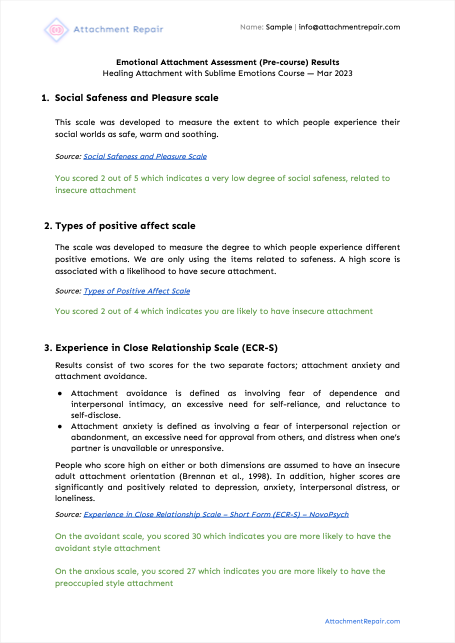
Sample Image

Practice Pods

Participants in this course have the option to join a practice pod. This is an informal group of 3-5 students who meet, usually once a week, to listen to a guided meditation, discuss difficulties in practice, and share insights and progress. Connecting with peer learners in this way can keep you motivated, consolidate learning, and create a sense of community.

Who is this for?

This program is for those of us who...

  • Have insecure attachment
  • Are looking to improve our psychological health, especially if we have tried other healing modalities with disappointing results
  • Have problems with emotional independence, exploration and sense of self (enmeshment)
  • Have troubles with expressing vulnerability
  • Difficulties with intimate relationships
  • Want to optimize our psychological health
  • Want to understand the early foundations of our psychological development
  • Have had trouble consolidating gains in meditation practice in spite of lots of dedicated meditation practice
  • Have difficulties with emotional regulation

Healing Together

Shared interest and social support can make meditation practice, study, and healing much easier.  Make friends in the course on the slack channel and invite friends who you think could benefit to participate in the course.

Benefits

These are some of the benefits you will have by the end of the program

Theoretical Understanding

  • A basic understanding of attachment theory
  • Understanding the path to \”earned secure attachment\”
  • Understanding of how attachment forms an important foundation of adult mental health
  • Familiarity with Jeffrey Young\’s Schemas (negative beliefs)

Psychological

  • A better ability to observe your mind with metacognitive awareness as a result of the mentalization exercises peppered through the guided meditations.
  • Better able to do emotional regulation on the spot in your daily life with ‘micro-hits’ of meditation
  • Less blame of self or others
  • Greater understanding and compassion for psychological problems and vulnerabilities that affect you and others
  • Less identification with your psychological maladies and quirks (ego-dystonia with your maladaptive schemas)
  • A more coherent and realistic understanding of the role your childhood experiences had in producing your adult personality

For your relationships

  • Understanding of how attachment conditioning unconsciously drives your relationship behaviors
  • Greater valuing of attachment itself
  • Better understanding of relationship dynamics
  • Less social anxiety
  • Greater ability and permission to be vulnerable and admit wanting closeness (dismissing/disorganized)

Support Structure

  • Join a weekly practice pod
  • A sense of camaraderie as a result of seeing how our psychological difficulties are rooted in common experiences that affect us all
  • Weekly attachment repair meditation that will start moving you towards secure attachment conditioning
  • Opportunities to find accountability partners to meditate with during the week
  • A sense of camaraderie as a result of seeing how our psychological difficulties are rooted in common experiences that affect us all
  • A Slack group to continue discussion during the week
  • Extra guided meditation session on Friday mornings at 8am Eastern Time (bonus)


“The slack group enhanced the experience and learning for me, maybe quadrupled the benefits I got. Reading and learning about other people’s experiences and also how you spent the time answering questions to help people with their practice” — Michelle

Frequently Asked Questions

About Participation

Once you sign up, an email will be sent out to you with a Zoom link. It will allow you to access the live classes. A free Zoom account is necessary, and Zoom needs to be installed on your computer before the event starts.
No, this course is open to anyone, regardless of your familiarity with attachment theory or prior meditation experience.
Yes, there is homework every week. Optimally you should listen to the meditation recordings (30 min) daily or every other day. However, while it is optimal for you to do it, the value of coming to class and doing meditation in class does not rely on you having done the homework. You’ll be assigned to a practice pod of 3 to 5 fellow students. It’s recommended that the practice pod sessions be spent listening to the meditation, discussing practice, and challenges.
Signing up late is perfectly fine. Because the course is practice-oriented, you should catch up by doing the practices in your own time. The recordings of the sessions you were not able to attend will be made available to you. You will be able to catch up on the material and do the meditations in your own time.
Yes, and in fact we highly encouraged you to do both.
The course has been designed for live attendance. All recordings are made available to you every week. It allows you to watch the recordings at home and do the meditations in your own time.
No, this is a meditation program, and is not the same as or a substitute for therapy.

Payment Questions

If for any reason you aren’t satisfied, simply contact us and we will send you a full refund.
If you are experiencing troubles with your payment, simply contact us and we will get back to you as soon as we can.

Technical Questions

The recordings will be made available as video and also as audio-only.

If you are experiencing any technical issues relating to accessing the material or live sessions, please get in touch with us. We will get back to you as soon as possible.

We can be reached with our online contact form.

Testimonials

This is what participants of prior Courses have to say:

N.P.

Loved the course and loved this kind of emotional work. Look forward to doing more that you offer. Content was excellent. Meditation around Schema modes went quite deep and uncovered difficult emotions. Doing micro hits has improved some situations that would have gone worse.

Anon

I’m sure this will seem out of the blue to you, but I was just thinking of things I am thankful for and thought of you and the two Attachment Repair courses of yours I had the pleasure to participate in. I just wanted to say a very heartfelt thank you. I want you to know I really appreciated the kindness and effort you put into that work, and into responding to all of our questions. My exposure to your teaching has been immensely helpful for me.

Chelsea

I gained an ability to self soothe, meet my needs for validation and feeling seen/heard (which were often unmet in childhood), an overall feeling like I am less alone in my work of healing my attachment. I realize I benefit greatly from an 8 week course with a weekly meeting, I am able to do daily meditations on my own and feel supported in this routine with the weekly meetings. I feel I am actively and consistently working on my attachment repair by being part of a longer course (as opposed to a weekend workshop).

Christine

Cedric is an amazing meditation teacher, and this course really changed a lot for me. I really liked his authentic, refreshing approach and the way he combines scientific research with A LOT of practical exercises to reprogram the mind. Over the time of the course, I could literally watch my self esteem and my motivation to get things done grow. The course really motivated me to get going with my business and get things done, because I started to believe that I can actually do it.

Dani

Thank you for continuing to make these classes. When I am able to attend, they make a really positive contribution to my mental health :)

Antoine

I’m very happy about the Embodying Secure Attachment Course. It’s good to have a course for people who are well on the way of healing their wounds. Comes at the perfect time for me.

Allyson

THANK YOU!! this is powerful for me, so thank you thank you for sharing your insight. I like how you really balance the “just do the work” attitude with sooo much compassion and empathy for how hard it is. Now I know how to use the immense power of my imagination to heal my most fundamental body-mind-soul mechanisms and have a more joyful, loving life.

Allison

I am enjoying the Healing Anxious-Preoccupied Attachment course so much! It's blowing my mind, and that's after decades of amazing therapy, EMDR, attachment couples therapy, neurofeedback, inner child nurturing, self-compassion, and many other profound growth experiences. I’m so delighted by how much I'm getting out of the course. Feels like it's a missing piece for me that is so healing. Thank you !

Johnny

I love your offerings. Keep them coming. You have a good capacity to make people feel seen – and also show great respect for us as individuals – in itself that is an healing factor in being in courses of yours! Your humbleness and humour – make every call a killer. Rock on. I like learning about these subjects! Feels very helpful in understanding my problems/reason to part of my suffering. I feel I have grown during the course so far – and or moving in a better direction.

Share this Event

Share this page with anyone you know who would be interested and would benefit from participating.

Please note: What is on offer here is meditation coaching, not psychotherapy or counseling.

Registration

This event is offered on a sliding scale to be accessible to anyone.

🎓 Scholarships: Inability to pay is no barrier to taking the class. Please fill in this form if you need a scholarship and we will accommodate you.

💵 Refund policy: If you are dissatisfied for whatever reason, simply let us know and we will issue you a full refund, no questions asked.

[2026-01] Attachment Theory & Repair

Additional information

Price Tier

Support Others, Normal Price, Discounted Price, Pay What You Can

Billing details

Additional information

Your order

Product
Quantity
Total
[2026-01] Attachment Theory & Repair - Normal Price
$300
Cart Subtotal $300
Order Total $300

Your personal data will be used to process your order, support your experience throughout this website, and for other purposes described in our privacy policy.

If you lack the ability to pay online (no Card, or lack of funds) contact us to request alternate options.

If you get an error during payment, please contact us saying "My payment method for Attachment Theory & Repair isn't working" and we'll send you other options.

If you miss a session or are dissatisfied for whatever reason, simply let us know and we will issue you a full refund, no questions asked.